Bipolar disorders are a group of illnesses characterized by alternating episodes of depression (the 'down' phase) and expansive mood episodes (the 'manic' phase if very intense, or 'hypomanic' or 'hypomania' phase if less intense, also referred to as the 'up' phase) occurring alternately. These are multifactorial diseases that combine genetic, neurobiological, psychological, and environmental vulnerability factors. The prevalence of these disorders in the general population varies depending on the definitions used: with a very restrictive definition, it is estimated that only 1 to 2% of the population is affected, while with a broader definition, it could involve up to 10% of people. Although the onset of the illness usually occurs in young adults (ages 18-20), a first episode can affect anyone, from childhood (early bipolarity) to elderly individuals (late-onset bipolarity).
Different types of bipolarity
Classically, two types of bipolar disorders are distinguished, which differ by the intensity of the expansive phase: bipolar disorder type I is characterized by the occurrence (at least once in a lifetime) of a manic episode, while bipolar disorder type II is defined by the occurrence (at least once in a lifetime) of a hypomanic episode. It is not necessary to have a depressive episode to speak of type 1 bipolarity (the manic episode alone is sufficient to 'sign' the diagnosis, which explains why this disorder can be mentioned in the presence of an inaugural manic episode), whereas experiencing a depressive episode is essential to refer to type 2 bipolar disorder. Indeed, in the latter case, the severity of the disorder is not related to hypomanic episodes (which often go unnoticed) but to the depression itself, which tends to be more resistant and is often inappropriately treated as unipolar depression (thus sometimes leading to unsuitable treatments).
The symptoms of bipolar disorders are varied as there are multiple clinical presentations, both for the down phases and the up phases, with symptoms that diverge in tone and intensity. As type 1 bipolarity associates [manic episode +/- depression] and type 2 bipolarity associates [hypomanic episode + depression], it is necessary to successively describe these three terms to properly understand what is being discussed.
The depressive episode: sometimes necessary, but not sufficient to speak of bipolarity
We refer you to the dedicated page, but as a reminder, a depressive episode is characterized by the presence of one or more of the following symptoms for at least two weeks:
- Depressed mood (sadness exceeding simple 'blues')
- Loss of interest or pleasure in almost all activities (anhedonia)
- Significant weight changes (loss or gain) or changes in appetite
- Insomnia or hypersomnia (excessive sleep)
- Agitation or psychomotor retardation
- Fatigue or loss of energy
- Feelings of worthlessness or excessive or inappropriate guilt
- Diminished ability to think, concentrate, or make decisions
- Recurrent thoughts of death, suicidal ideation, or suicide attempts
To receive a diagnosis of a major depressive episode, a person must have at least 5 of these symptoms (including either loss of interest/pleasure or depressed mood). Additionally, these symptoms must cause significant distress or impairment in the person's functional ability, meaning they must have a real impact: it is not a transient low mood, an individual suffering from depression experiences intense suffering. (Deniker Foundation)
It is therefore not easy to distinguish a unipolar depressive episode from a bipolar depressive episode since they share most of the symptoms. However, experienced practitioners pay close attention to different 'red flags' that may indicate a depression that is more bipolar than unipolar:
- An atypical dimension, in the sense of atypical depression: hypersomnia, hyperphagia, heaviness of limbs, hypersensitivity to rejection, etc.
- A seasonal dimension: worsening of episodes depending on the seasons with patients who are more likely to have severe episodes in winter (although some minority patients experience the opposite with episodes occurring only in summer)
- A hormonal dimension: particularly in cases of postpartum depression (more frequent in bipolarity) or in cases of a clear association of the disorders with premenstrual syndrome, etc.
The manic episode: the marker of type 1 bipolarity
Concerning the symptoms of a manic episode, as described in the DSM-5:
- Abnormally elevated, expansive, or irritable mood for at least one week
- Increased self-esteem or grandiosity, or feelings of being invincible
- Decreased need for sleep
- Increased speech, with a feeling that the words are rushed and difficult to interrupt
- Flight of ideas or sensation of thoughts colliding
- Increased distractibility or attention to multiple tasks at the same time
- Increased goal-directed activity or psychomotor agitation
- Excessive involvement in pleasurable but risky activities, such as compulsive shopping, unprotected sexual behaviors, or reckless financial investments.
In general, the person will be accelerated, abnormally euphoric or irritable, will not sleep while feeling very well, sometimes getting up at night to be active, thoughts will race so fast that it is difficult to keep track, activities succeed and flow sometimes without coherence, with an overall impression, from an external viewpoint, that things are disorganized. This is an intense state that sharply contrasts with the patient’s usual habits; those around them are often worried about this state, even if initially things may be minimized or trivialized. In this extremely intense 'up' phase, patients are at high risk: risk of acting out, risk of fighting, risky behaviors (sex, drugs, etc.), poor decision-making (separation, marriage on a 'whim'), excessive spending with a risk of massive debt. In some cases, the symptoms of excitement are so intense that the patient 'loses touch with reality', leading to a manic episode with psychotic features. In this form of mania, the patient disconnects from reality with the emergence of delirium that can be congruent with the mood (in other words, the delirium itself is linked to the excitement, such as megalomaniac delusions) or incongruent (e.g., paranoia, hallucinations, etc.).
To receive a diagnosis of a manic episode, a person must present at least three of the symptoms listed above (four if the abnormal mood is only irritable) and these symptoms must cause significant disruption in the person's functioning. This disruption is usually so intense that only hospitalization can put an end to the episode.
Although there are as many clinical presentations of a manic episode as there are patients, a good illustration of this state is found in Homeland, where the character Carrie (the heroine of the series) suffers from bipolar disorder. The following excerpt is in English but allows one to see the psychomotor acceleration.
The hypomanic episode: marker of bipolar disorder type 2 if the patient has already experienced a depression
A hypomanic episode is a sort of 'mini manic episode', that is, a phase that is much less visible (which is not always detected, as people feel they are just 'doing very well'). An abnormally elevated, expansive, or irritable mood is observed, lasting at least 4 days. The symptoms of a hypomanic episode are less intense than those of a manic episode and do not lead to marked impairment in social or professional functioning. The three main symptoms of a hypomanic episode are:
An exalted mood: the mood is abnormally elevated (almost euphoric or irritable). People often feel very well and express their joy through demonstrative and more uninhibited behaviors. They may dress in a way that contrasts and is inappropriate for the weather. Their facial expressions are joyful, the tone is cheerful, and the person may be hypersyntonic. Hypomanic individuals can also be very active, feeling capable of undertaking oversized projects, including those outside their fields of expertise. However, unlike in a manic episode, individuals in a hypomanic state generally do not engage in risky behaviors or reckless investments.
Psychomotor acceleration: Individuals in a hypomanic phase experience psychomotor acceleration characterized by tachypsychia (acceleration of thoughts) associated with rapid verbal output (logorrhea). The speech is difficult to follow due to many non-sequiturs and a flight of ideas. Individuals in a hypomanic state can be very creative and playful, with wordplay and original associations, but their discourse may lack coherence and relevance. Hypomanic individuals may also display uninhibited behavior, but this is less extreme than that of individuals in a manic state.
Associated somatic signs: Hypomanic individuals may have a decreased need for sleep, but this insomnia is generally not total and is often described as 'without fatigue'. Eating habits may be erratic, with increased consumption of alcohol and other psychostimulant substances, but less marked than during a manic episode. Libido may also be increased, but risky sexual behaviors are less frequent. In general, the somatic signs associated with the hypomanic episode are usually less pronounced than those of the manic episode.
The hypomanic episode is often difficult to diagnose as it is often minimized or trivialized by patients and their surroundings: it is 'a good phase', 'a good period', 'it is nice to see them like this', and ultimately it can sometimes be very difficult to know whether this state is pathological or not. Moreover, in general, it is difficult to say that hypomania is pathological per se: it is its association with episodes of severe depression that are clearly pathological that makes it a pathological entity. However, an individual who does not suffer from depression and only experiences hypomanic episodes at regular intervals would even be rather advantaged compared to others because in these phases, patients tend to be more productive, more active, more creative, and even though after a while they tend to have difficulties organizing themselves, these are still periods during which they can be very productive (overperforming at work, starting businesses, painting, writing, etc.). The severity of the disorder (and some authors believe that type 2 bipolar disorder is more serious than other disorders) lies in the severity of the depression, which will be longer, more severe, harder to treat, harder to diagnose, sometimes with a diagnostic delay of 8 to 10 years (as depressions are mistaken for non-bipolar depressions).
The state of hypomania is sometimes considered itself to be at risk for several reasons: first because it lays the groundwork for depression ('when it goes up, it must come down; the longer hypomania lasts, the harder the depression will be'), and secondly because even if the disorders are less clear than in mania, disinhibition, poor choices, and risky behaviors can negatively impact the prognosis, as highlighted at the 2019 Encéphale Congress with a thematic session dedicated to 'hypomania: the state of all dangers'.
Do not confuse the different forms
A common confusion is made between different forms of episodes, especially as it is now important to understand some additional concepts: euthymia, mixed episodes, cyclothymia, the notion of bipolar spectrum.
Bipolar disorders are characterized by "an alternation of episodes": in other words, a patient will experience several pathological episodes, but each episode has a beginning and an end. A patient may go through several episodes of depression, episodes of depression with manic episodes, etc. Between episodes, the mood is stable, the patient does not present any symptoms, they are neither in a depressive phase nor in a phase of exaltation, the mood is appropriate (sad when there are reasons to be sad, happy when there are reasons to be happy). The best way to understand how an episode evolves is to create a mood chart (also called a thymogram) to visually represent mood fluctuations.
For example, in this patient, we observe a first severe depressive episode followed by a second episode of less severity but of longer duration (with a much more gradual return to euthymia) and finally followed by a hypomanic episode (this is therefore a type 2 bipolar disorder):
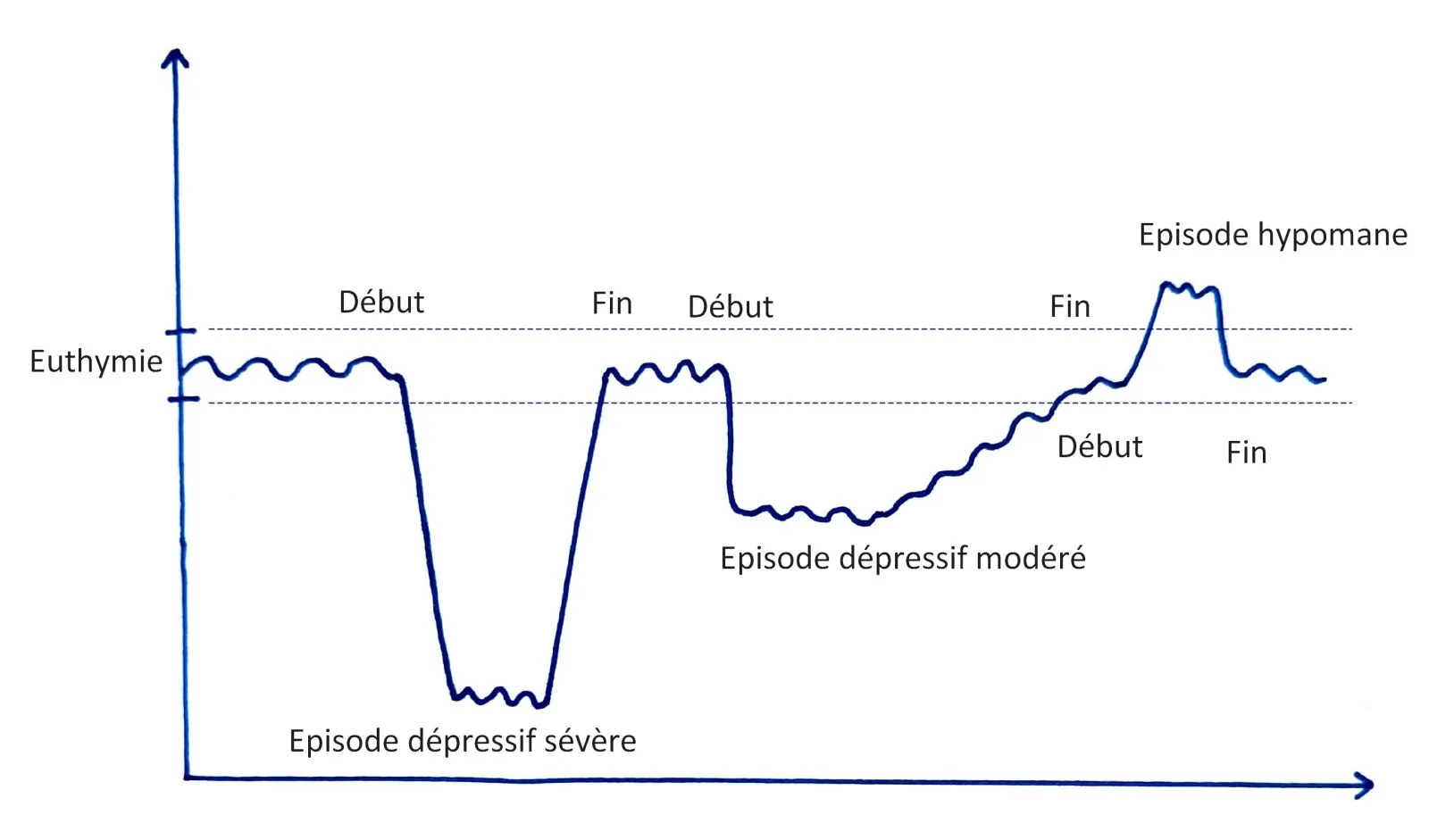
Example of a thymogram of a patient presenting with type 2 bipolar disorder.
In this second example, the patient first presents a hypomanic episode, followed by a manic episode (this is therefore a type 1 bipolar disorder), followed by a depressive episode and finally a mixed episode (see below):
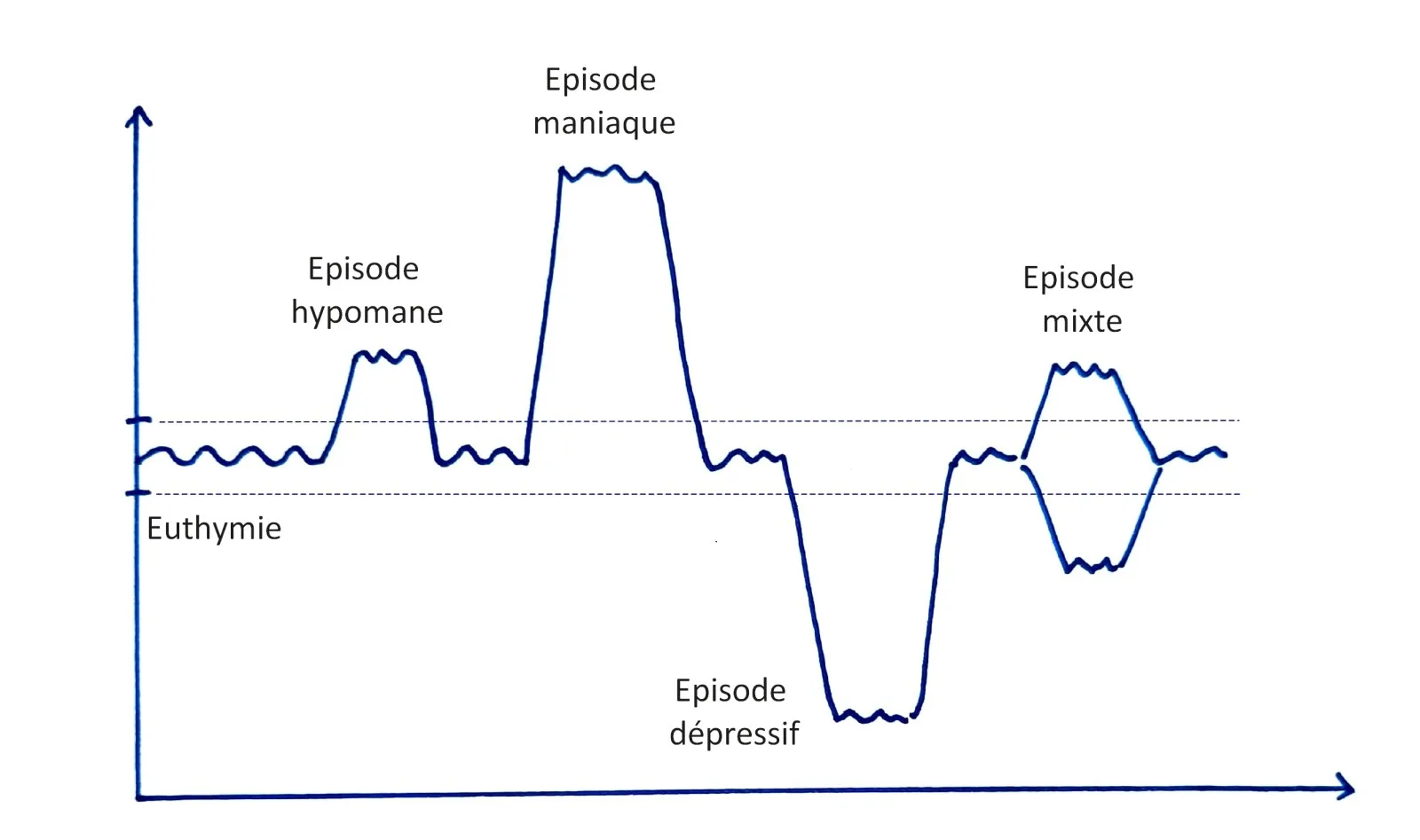
Example of a thymogram of a patient presenting with type 1 bipolar disorder.
Lastly, for this third patient, we see a cyclothymic phase followed by a depressive phase that seems to persist long-term (which could thus suggest a persistent depressive disorder if this lasts several years):
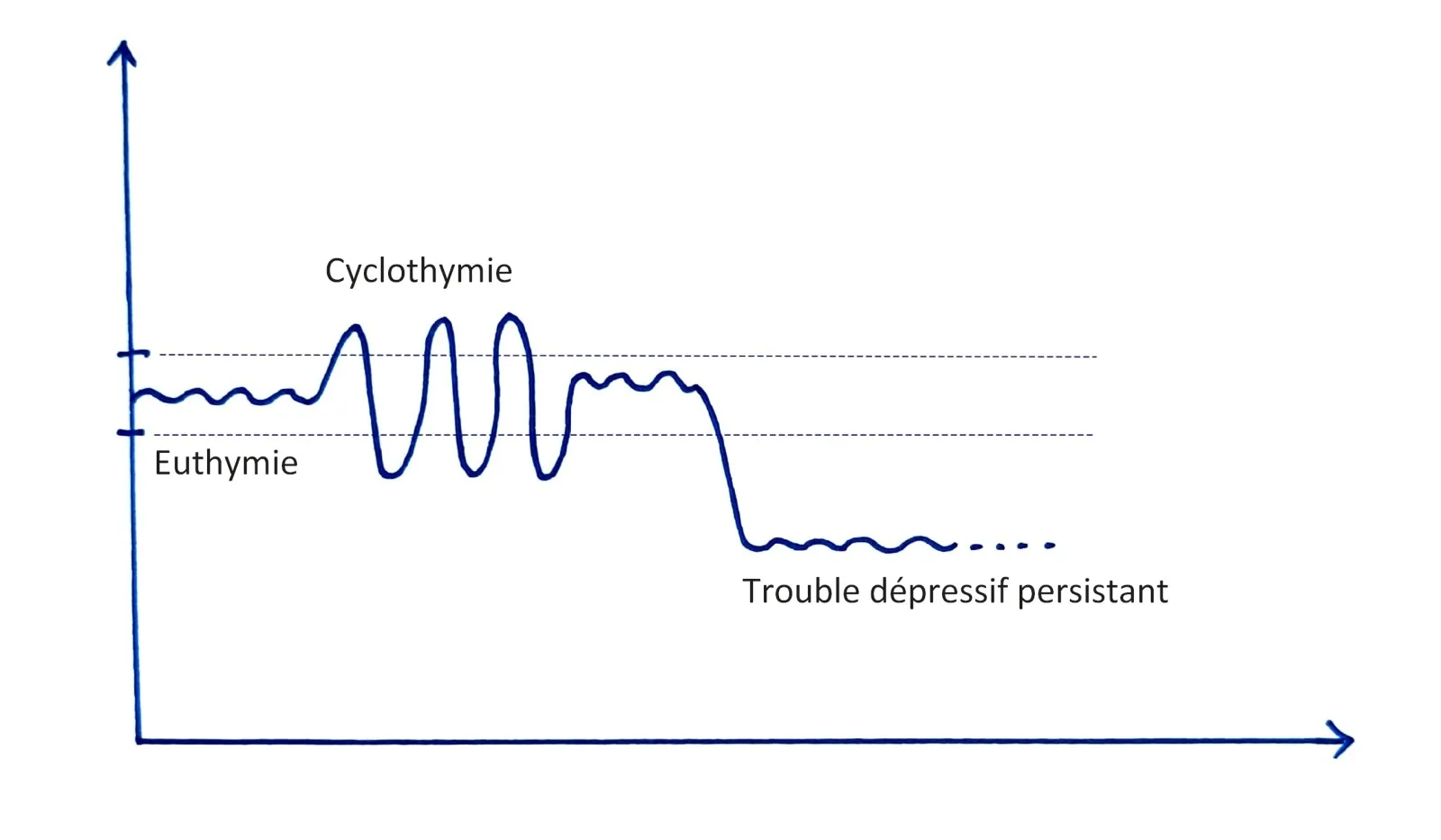
Example of a thymogram of a patient presenting with a cyclothymic phase followed by a persistent depressive disorder.
This allows for the introduction of several additional concepts:
A mixed episode refers to the coexistence of manic and depressive symptoms during the same episode (and not in alternation). The person will thus experience conflicting emotions simultaneously or within the same day, with a highly changeable mood ranging from euphoria to sadness to irritability. This episode can therefore have extremely diverse clinical presentations, making diagnosis even more challenging.
Cyclothymia is a disorder characterized by recurrent periods of euphoria and mild depression. The periods of euphoria are not elevated or expansive enough to be considered hypomanic episodes (let alone manic), and the depressive symptoms are insufficiently severe or prolonged to be classified as a depressive episode. Patients often describe significant distress related to the frequent and sometimes abrupt mood fluctuations, willingly stating that they do not know what state they will wake up in the next day, being able to go to bed feeling euphoric and wake up almost depressed. As we will see below, this could constitute a particular form of bipolarity according to some authors.
Moreover, another concept to understand is that of "mood shift". We speak of a shift when the mood suddenly (generally) transitions from a down episode to an up episode (this is then referred to as a hypomanic shift or a manic shift) or from an up episode to a down episode (then it is referred to as a depressive shift). When a manic or hypomanic episode occurs after taking an antidepressant in someone who has never experienced one, it is also classified as a bipolar disorder. Previously, this was referred to as type 3 bipolar disorder ("manic or hypomanic shift under antidepressants"), but for a few years now, it has been considered type 1 bipolar disorder in the case of a manic shift and type 2 bipolar disorder in the case of a hypomanic shift.
The bipolar spectrum
Finally, it is also important to understand the notion of "bipolar spectrum". For a long time, disorders were considered categorically ("you either have it or you don't"), while there is an increasing recognition of dimensional perspectives ("one can have elements of a disorder, some dimensions more than others, etc."). In other words, we move from the hypothesis of a disorder that one either has or does not have, to an hypothesis where it is possible to have it to some degree (e.g., 5%), moderately (e.g., 50%) or largely (e.g., 90%). In this hypothesis, it is thus possible to identify sub-clinical or infra-clinical forms of mood disorders that share characteristics with bipolar disorders, but without being classified as type 1 or type 2 bipolar disorders. This spectrum also includes other types of bipolarities that have more blurred and sometimes more questionable boundaries. Professor Hagops Akiskal has extensively researched this issue to the point that we sometimes refer to Akiskal's classification of bipolar disorders, or the "extended spectrum" classification including:
- Type 4 bipolarity, which would correspond to a cyclothymic temperament characterized by fluctuations of insufficiently consistent up or down symptoms to constitute real episodes, but whose fluctuations contribute to the severity of the disorder
- Type 5 bipolarity, which would correspond to a hyperthymic temperament (that is to say, people who have a permanently exalted temperament: go-getters, "locomotives", perpetual life-of-the-party types, etc.) associated with phases of depression
- Type 6 bipolarity, which would correspond to the association of a borderline or histrionic personality disorder with characterized depressive episodes. Some also include in this type the association of Attention Deficit Hyperactivity Disorder (ADHD) with a mood disorder.
It should be noted that according to the DSM-5, only type 1 and type 2 bipolarities are recognized, although there is a relative consensus for types 3 and 4. However, types 5 and 6 are much more debated and controversial.
Within type 1 and 2 disorders, other clinical particularities have been highlighted, notably an entity called "rapid cycling bipolarity". This disorder, characterized by alternating episodes in close succession (4 mood episodes in a year), can sometimes be more complicated to treat, and some so-called "ultra-rapid" forms (which can sometimes lead to ultradian cycles) resemble a cyclothymia that exhibits the severity characteristics of episodes, making it even more challenging.
Finally, we will also mention schizoaffective disorders, which belong to the bipolar spectrum only marginally as they are currently considered to be the association of a bipolar disorder and schizophrenia, with an intermediate prognosis between the two (better than schizophrenia, and more reserved than bipolarity), characterized by the persistence of suggestive schizophrenia symptoms between mood episodes.
Management of bipolar disorders
This involves specialized management that primarily requires a complete diagnostic assessment, particularly in cases of bipolar spectrum disorder or type 2 bipolarity for which significant debates and diagnostic delays are known to occur. Indeed, it is relatively easy to diagnose type 1 bipolar disorder in a patient who has experienced a manic episode in their lifetime (one episode is sufficient, even if it occurred a long time ago), but it is more challenging for type 2 bipolarity since hypomanic episodes are often poorly identified.
Once the diagnosis has been established with the greatest certainty possible (knowing that in some cases it is not possible to establish a formal diagnosis: generally the healthcare professional does not see the patient in the mild or moderate up phases), management relies on a triad:
Psychotherapy: the challenge in these disorders, which are heavily underpinned by neurobiological processes (and even genetic), is not necessarily to conduct a "classic" psychotherapy, but rather to address in psychotherapy the factors that could precipitate or exacerbate an episode or lay the groundwork for a relapse. It is particularly important to thoroughly understand the disorder, which is why psychoeducation holds a central place in management, and the same goes for therapeutic education.
Stabilization of the environment: this pathology requires an environment that is as stable as possible (regular hours, preservation of sleep which is essential, etc.), and ideally a distancing from stressors. Sleep is notably considered by some as a cornerstone in management.
Medications: mood stabilizers are the necessary (but sometimes insufficient) treatments for bipolar disorders. The combination of a stabilizer with an antidepressant is sometimes necessary for short durations when it is impossible to do otherwise, but it is the stabilizers that should be at the center of the medication management. Moreover, other types of strategies (thyroid hormones, psychostimulants, etc.) are also being tried with varying degrees of success, particularly for the treatment of depressive phases.
Other approaches can also be offered, especially in specialized centers, such as certain neurostimulation techniques that are regularly used in practice to treat resistant depressive episodes, with some protocols appearing promising for up phases as well, and some studies have found the benefit of associating neurostimulation with thyroid hormones to stabilize patients (but these results would need to be replicated).
Finally, lifestyle hygiene (which contributes to stabilizing the environment) must become a priority: stopping tobacco and cannabis and other drugs, limiting alcohol consumption, maintaining physical activity, maintaining a diet rich in fiber and protein (green vegetables, salads, legumes), reducing carbohydrates (favoring brown rice over pasta and potatoes), reducing meat (favoring white meats like turkey) and dairy (replacing yogurts with unsweetened applesauce), eliminating refined sugars (for example, in pastries) and minimizing saturated fats (Junk Food), maintaining social contacts, and maintaining contact with nature.
Some useful links and references
- Goupil or Face, on cyclothymia
- CTAH Association, Dr. Elie HANTOUCHE's website
- Inicea (private clinics), site with resources written by Pr. FERRERI, Dr. MOUCHABAC, Dr. BOURLA
- Deniker Foundation, foundation for mental health research
- Fondation Fondamental, foundation dedicated to the fight against psychiatric disorders